


How to Play Dota 2: A Comprehensive Guide for New Gamers

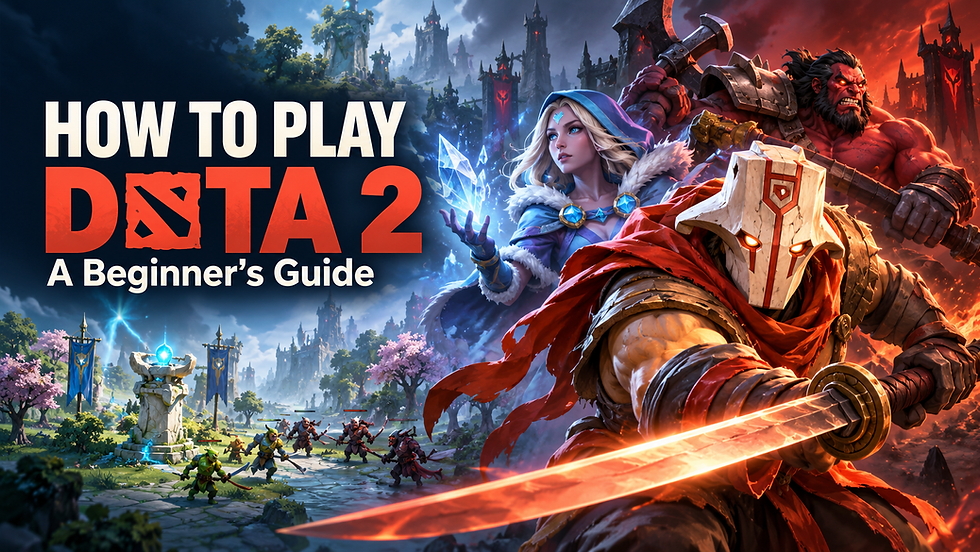
Dota 2 is a complex, free-to-play multiplayer online battle arena (MOBA) where two teams of five players battle to destroy the other’s “Ancient,” a heavily defended structure located in their respective bases. Success requires strategic team play, understanding character abilities, and adapting to constantly shifting circumstances.
After reading this guide, you’ll understand the fundamentals of Dota 2 and be equipped to confidently navigate its intricacies. You’ll be able to grasp the core concepts of the 'Match Structure and Objectives', learn about 'Heroes and Items: What You Need to Know', and even appreciate the 'Development and Origins from Modding Community' behind this enduring title.
Key takeaways
·Dota 2 is a free-to-play multiplayer online battle arena (MOBA) where two teams of five players battle to destroy the other’s “Ancient,” a heavily defended structure located in their respective bases.
·Dota 2 features a roster of over 120 heroes Grokipedia, each possessing unique abilities and roles, and a vast item system that shapes gameplay.
· A standard Dota 2 match is a two-team, five-player battle focused on destroying the opposing team's "Ancient," a large structure located within their base Valve eSports.
·Dota 2 began as a community-created mod for Warcraft III: Reign of Chaos, demonstrating the power of player creativity within game engines IceFrog's Blog.
·Valve’s involvement began in 2009 when the company noticed the burgeoning popularity of the Defense of the Ancients (DotA) community mod for Warcraft III: Reign of Chaos IceFrog's Blog.
Dota 2 vs League of Legends: A Comparison
Dota 2 and League of Legends are both popular multiplayer online battle arena (MOBA) games, but they differ significantly in gameplay complexity and core design. While both involve teams of players battling to destroy an opponent's base, the mechanics and depth of Dota 2 present a steeper learning curve than League of Legends Grokipedia. This difference stems from several key areas.
Dota 2's itemization system is far more expansive, with items often having multiple active abilities and complex interactions. League of Legends, conversely, features a more streamlined approach to item builds. Furthermore, Dota 2’s hero abilities often have longer cooldowns and more nuanced effects, requiring greater strategic thinking and team coordination to play dota effectively Grokipedia.
The player base reflects these distinctions. League of Legends generally attracts a broader audience seeking a more accessible experience, while Dota 2’s community tends to be comprised of players who appreciate its depth and complexity Grokipedia. This isn't to say either game is "better," but the design choices lead to distinct experiences.
Heroes and Items: What You Need to Know
Dota 2 features a roster of over 120 heroes Grokipedia, each possessing unique abilities and roles, and a vast item system that shapes gameplay. Understanding how these elements interact is crucial for success in the game. Initially, players select one hero from the available pool at the start of a match, considering team composition and personal playstyle. Some heroes are consistently popular due to their effectiveness or engaging mechanics.
Heroes fall into categories like carry, support, mid, offlane, and roamer, influencing their typical positioning and responsibilities during a match. Item choices are equally important; they enhance hero stats, grant new abilities, or provide utility for the team. Items can be purchased from shops using gold earned through killing creeps, enemy heroes, and completing objectives.
Upgrading items is a key aspect of progression. Many items have multiple tiers, requiring specific recipes and gold to evolve into more powerful versions. For instance, a "Ring of Regeneration" can be upgraded to a "Ring of Health," providing increasingly potent healing effects. Effective itemization requires anticipating enemy strategies and adapting to the flow of the game.
Match Structure and Objectives
A standard Dota 2 match is a two-team, five-player battle focused on destroying the opposing team's "Ancient," a large structure located within their base Valve eSports. The gameplay unfolds across a symmetrical map, divided into three lanes, top, middle, and bottom, connected by a jungle area. Success requires a strong understanding of teamwork and strategic decision-making; even experienced gamer reviews often highlight these elements.
Each team begins the match with a set of defensive structures, including towers and barracks, protecting their Ancient. Destroying these structures is crucial for advancing toward the enemy base, but it is not the sole objective. Controlling the jungle areas to farm resources and gain experience is equally important for hero progression, a key consideration for any serious gamer.
The match progresses through phases, with the early game focused on lane control and farming, the mid-game centered around team fights and objective pushing, and the late game demanding coordinated strategies for securing the victory. Effective communication and coordination between teammates are vital for achieving these goals, and many gamer reviews emphasize the importance of these skills.
Development and Origins from Modding Community
Dota 2 began as a community-created mod for the original Warcraft III: Reign of Chaos and its expansion, The Frozen Throne, demonstrating the power of player creativity within game engines IceFrog's Blog.
The initial mod, known as Defense of the Ancients (DotA), was inspired by an earlier mod called "Aeons of War" DotaWIKI. Players modified Warcraft III to create this experience, leveraging the game's directx capabilities to build a unique, team-based battle arena.
The mod's popularity rapidly grew, attracting a dedicated community of players and modders who continually refined the gameplay and added new content. As the mod evolved, multiple individuals took on the role of lead developer, with "Guinsoo" and "IceFrog" being particularly notable DotaWIKI. It was IceFrog who ultimately spearheaded the transition to Dota 2, a standalone game developed by Valve Corporation.
Valve recognized the potential of the mod and began supporting its development, providing resources and infrastructure to create a polished, standalone experience Dota2.com. This transition allowed players to learn and master the game without the limitations imposed by Warcraft III's engine, ultimately leading to Dota 2’s emergence as a global esports phenomenon.
Valve's Involvement and Pre-Release
Valve’s involvement began in 2009 when the company noticed the burgeoning popularity of the Defense of the Ancients (DotA) community mod for Warcraft III: Reign of Chaos IceFrog's Blog.
Recognizing the talent and passion within this player-driven scene, Valve decided to sponsor and officially support the development of a standalone sequel, Dota 2, under the direction of programmer Steve “Guinsoo” Feak. This marked a significant shift, bringing substantial resources and expertise to what had previously been a community-led project.
Initially, IceFrog, a prominent figure in the DotA modding community, continued to lead development. Valve provided infrastructure, tools, and personnel, allowing the team to focus on refining gameplay and building out the game's features. The pre-release phase was characterized by frequent updates and experimentation, with Valve actively soliciting feedback from the community through beta testing and forums. This collaborative approach shaped the game’s evolution and fostered a strong connection with players.
The open beta, launched in 2011, allowed a wider audience to experience Dota 2 and provide valuable input. Valve’s support enabled the creation of a robust anti-cheat system and dedicated servers, enhancing the overall player experience. This also facilitated the eventual option to purchase cosmetic items and battle passes, a key component of the game’s ongoing funding model.
Reborn Engine and Post-Launch Updates
The Reborn Engine replaced the original Source Engine in 2015, fundamentally overhauling the game’s infrastructure to address technical limitations and pave the way for significant improvements Dota 2 Blog.
This transition was necessary to support the game's growing complexity and ambitious feature requests. Prior to Reborn, the older engine struggled with rendering large numbers of units and effects, impacting performance in high-resolution settings.
Valve implemented the new engine to enable features like improved visual fidelity, enhanced physics, and a more robust networking system. The engine’s architecture allows for more efficient handling of complex interactions, such as those involving numerous heroes and an array of an item. This also provided a foundation for future expansions and gameplay changes.
Post-launch updates have consistently built upon the Reborn Engine's foundation. These updates have not only addressed bugs and balance issues but also introduced substantial quality-of-life enhancements, such as improved matchmaking and spectator tools. The ongoing development demonstrates Valve's commitment to refining the gameplay experience and ensuring the game remains competitive.
Release and Business Model
Dota 2 initially began as a standalone mod for Warcraft III: Reign of Chaos and its expansion, The Frozen Throne, before evolving into a standalone game. Valve officially launched Dota 2 in July 2013, following an open beta period that began in 2011 Valve. The game's development involved significant community feedback and iterative improvements, shaping its final form.
The game operates on a free-to-play business model, meaning the core experience is accessible without upfront cost. Revenue is generated through in-game purchases, primarily cosmetic items and battle passes. These purchases do not affect gameplay balance, ensuring a level playing field for all players.
Here's how the system works:
1.Cosmetic items: Players can purchase alternate character appearances, weapon skins, and other visual customizations.
2.Battle Passes: Seasonal passes offer a tiered reward system, granting cosmetic items and other bonuses as players level up through gameplay.
3.Compendiums: During major tournaments, Compendiums offer a similar reward structure, tied to specific in-game events and community goals.
Valve’s approach prioritizes a non-pay-to-win structure, focusing on optional cosmetic enhancements to sustain the system Valve.
Launch Timeline and Platforms
Dota 2 initially emerged as a standalone modification for the original Warcraft III: Reign of Chaos and its expansion, The Frozen Throne, before transitioning to a dedicated client. Its formal launch occurred in 2013 with the release of the Dota 2 standalone client on Valve's Steam. This marked a significant shift from its earlier, mod-based existence.
The game’s availability has consistently focused on digital distribution, primarily through Steam. While there have been occasional promotions and bundles outside of Steam, the platform remains the central hub for acquiring and playing Dota 2. This strategy reflects Valve’s commitment to online distribution models.
Dota 2 is accessible on both Windows and macOS operating systems, ensuring a broad player base can participate. The game's cross-platform play allows users on both systems to compete against each other in online matches.
Monetization and Free-to-Play Aspects
Dota 2 operates on a free-to-play model, meaning the core game itself is accessible without any upfront cost Valve. Revenue is primarily generated through in-game purchases, specifically cosmetic items and battle passes, which directly fund ongoing development and support for the game. This approach distinguishes it from many other titles that rely on subscription fees or pay-to-win mechanics.
The most significant revenue stream comes from cosmetic items, which alter the appearance of heroes and structures without affecting gameplay Valve. These items range from simple color variations to elaborate, animated sets, and are often traded on the Steam Marketplace. Battle passes, introduced in a later version, offer a tiered system of rewards earned through gameplay and purchasing, further incentivizing player engagement.
Valve’s approach avoids pay-to-win elements, ensuring a competitive balance for all players regardless of spending habits Valve. This commitment to fairness has been a key factor in the game's sustained popularity and robust community.
Frequently asked questions
How do you play Dota 2?
Dota 2 is a free-to-play multiplayer online battle arena (MOBA) where two teams of five players compete to destroy the other’s "Ancient," a heavily defended structure located in their respective bases Dota 2 on Steam. Players select from a roster of over 120 unique heroes, each with distinct abilities and roles, and work together to outmaneuver and defeat the opposing team Grokipedia. Matches typically last between 25 and 50 minutes, demanding strategic thinking, teamwork, and mechanical skill.
When was Dota 2 released?
The initial release of Dota 2 occurred in 2013, although its development began much earlier as a mod for Warcraft III esports.gg/guides/dota-2/dota-2-release-date/. The game’s origins trace back to a custom map called Defense of the Ancients, which gained immense popularity within the Warcraft III community The Story of DOTA | Eurogamer.net. Continuous updates and expansions have shaped the game into its current form.
How many heroes are in Dota 2?
Currently, Dota 2 features a hero pool of over 120 distinct characters, each possessing unique abilities and playstyles Grokipedia. Valve, the game's developer, regularly introduces new heroes and updates existing ones to maintain a dynamic and evolving gameplay experience. This vast selection provides players with numerous strategic options and encourages diverse team compositions.
What makes Dota 2 different from other MOBAs?
Dota 2 distinguishes itself from other MOBAs, such as Heroes of the Storm gamespot.com, through its complex item system, high skill ceiling, and emphasis on strategic depth Grokipedia. The game’s mechanics, including denying creeps and intricate hero interactions, demand a higher level of mechanical proficiency and teamwork compared to some alternatives. These factors contribute to Dota 2's reputation as a challenging and rewarding competitive experience.


Comments